







Dye penetrant test kits, which are also called DP test kits or DPT kits, are key instruments for finding surface defects such as cracks, seams, porosity or leaks in metals and other non-porous materials. Their speed, accuracy and low cost make them extremely useful wherever safety and reliability cannot be compromised.
What Is a Dye Penetrant Test Kit?
A Dye Penetrant Test Kit is a simple yet effective way to reveal surface flaws in metals and other solid materials. Commonly known as a DP Test Kit, it relies on a coloured or fluorescent dye penetrant that seeps into cracks and makes even very small defects visible. The part is not harmed by the process, so it is ideal for checking welds, inspecting castings and carrying out routine maintenance.
Stanvac International supplies dependable dye penetrant testing equipment that lets technicians spot hidden defects quickly before they lead to failure. That is why the method is essential in industries built on precision and safety.
Components of a Dye Penetrant Test Kit
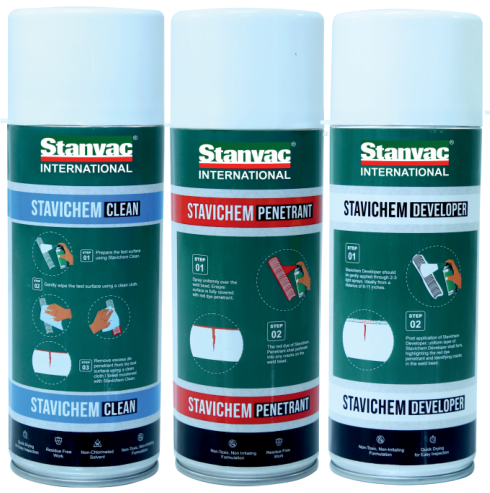
A full Dye Penetrant Test Kit contains three main components, and each has its own part in detecting defects accurately.
Cleaner or Remover
The cleaner takes away oil, grease, dust and other surface contamination. The surface must be clean because foreign particles can mask defects and reduce how well the penetrant shows up.
Penetrant
The penetrant is a liquid with a bright colour or fluorescence. Once applied, it moves into cracks and openings by capillary action, which brings out even the smallest surface flaws.
Developer
The developer draws the penetrant back up to the surface so that defects can be seen clearly. It forms a contrasting background against which cracks and pores are easy to pick out during inspection.
Our DP Test Kit is made from premium-grade materials to give precise, consistent results that are easy to read.
How to Use a Dye Penetrant Test Kit for Surface Defect Detection
The DP Test Kit is used in a straightforward sequence of steps. Followed properly, the method gives clear and dependable inspection results.
Step 1: Clean the Surface
Spray the cleaner over the test area and wipe off the contaminants. The surface should end up dry and free of rust, oil, paint and dirt.
Step 2: Apply the Penetrant
Apply the penetrant evenly over the area by spraying or brushing. Leave it for the specified dwell time so that capillary action can carry it into cracks.
Step 3: Remove Excess Penetrant
Use a clean cloth to wipe off surplus penetrant. Take it off the surface only, and do not wash it out of the crack.
Step 4: Apply Developer
Shake the developer can and spray on a thin, even coat. The developer pulls trapped penetrant out of cracks so the flaws become visible.
Step 5: Inspect the Surface
Look at the surface in suitable lighting. Cracks and defects show up as bright lines or coloured marks. Record the size, shape and orientation of each flaw.
Step 6: Clean After Testing
Once the findings are documented, clean the surface again to remove leftover developer and penetrant.
Our Dye Penetrant Test Kit gives excellent visibility and works well for inspections in the field as well as the workshop.
Advantages of Using the DP Test Kit
The penetrant test kit brings many performance benefits, which is why quality assurance and maintenance teams prefer it.
Very sensitive to fine cracks
Quick, simple application at every level of inspection
Effective on metallic and non-porous surfaces
Smooth, clean developer spray for accurate visibility
Fits routine maintenance, certification inspections and production quality checks
Safe on stainless steel, cast iron, aluminium and many alloys
Made in compliance with international NDT standards
Industries that put safety and defect-free operation first find the kit highly dependable.
Industries Benefiting from Dye Penetrant Testing
Many industrial sectors depend on dye penetrant testing. The Dye Penetrant Test Kit is widely applied in areas such as:
- Aerospace: Checking turbine blades, landing gear, engine parts and structural components.
- Automotive: Examining welds, axles, brake parts, cast components and chassis joints.
- Oil and Gas: Testing of pipelines, valves, drilling tools and refinery equipment.
- Railways: Inspecting bogie frames, wheels, rails, couplers and structural parts.
- Fabrication and Welding: A welding DP test serves as a quality check on weld joints, pressure vessels, storage tanks and steel structures.
- Power Plants: Examining turbines, boilers, cooling systems and high-temperature components.
In each of these industries, catching defects early prevents failures and protects long-term safety.
Compliance and International Standards for Dye Penetrant Testing
Each DP Test Kit we supply is made to comply with the main global standards for non-destructive testing, which assures consistent, dependable results in every application.
Standards commonly followed include:
- ASTM E1417
- ISO 3452
- ASME Boiler and Pressure Vessel Code
- EN testing standards
Meeting these norms means our Dye Penetrant Test Kit satisfies the quality and safety benchmarks followed around the world.
Why Choose Stanvac International for Dye Penetrant Test Kits
Stanvac International is a dependable supplier of high-sensitivity DPT kits and DP test kits for industry professionals.
When you choose us, you get:
- Premium grade penetrants and developers for accurate flaw detection.
- Products made to reveal even microcracks in welded and cast components
- Formulations that are safe on all major metals, including mild steel, stainless steel, cast iron and aluminium.
- NDT quality standards that are approved internationally.
- Advanced manufacturing processes that safeguard quality.
- Supply to customers worldwide, so testing kits are easy to obtain.
- Decades of experience in welding consumables and non-destructive testing tools.
Welding electrodes are not all we make: we also make sure industries can obtain the right testing solutions to keep quality and safety on track.
Frequently Asked Questions
Which materials can be inspected with a dye penetrant test kit?
How does dye penetrant testing work?
Which safety precautions apply during dye penetrant testing?
How should I choose a dye penetrant test kit?
Which industries rely on dye penetrant testing?
Why does a welding DP test matter?
Does a die penetrant test kit mean the same thing as a dye penetrant test kit?
Let’s find your welding solution.
Share your requirements. We’ll help you take the next step.