







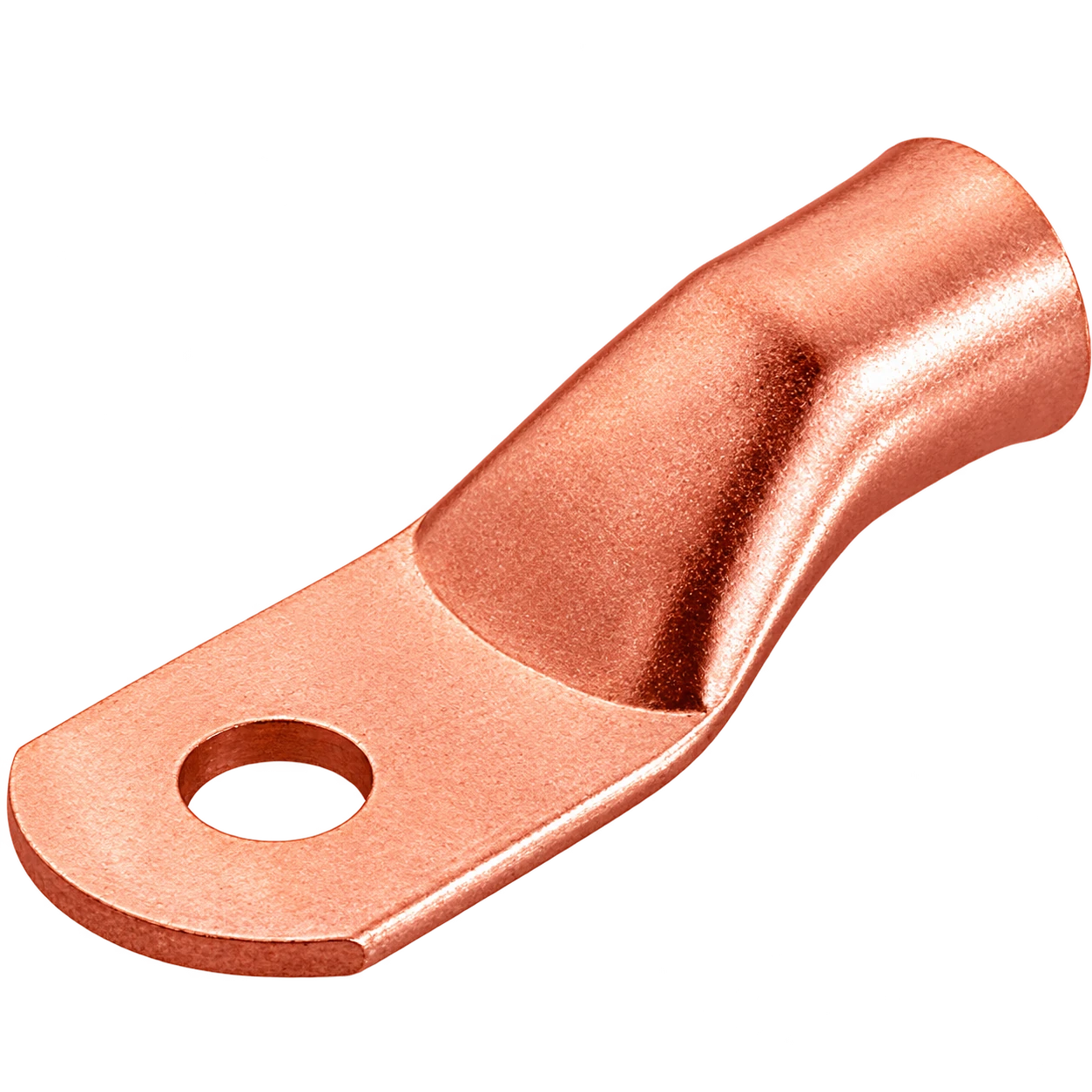
CABLE LUG
Stanvac International CABLE LUGS terminate welding and power cable at holders, earth clamps, machine panels and bus bars. Eight models cover cable from 10mm² (#7 AWG) up to 120mm² (4/0 AWG), each with a matched cable hole and stud hole so the crimp seats correctly and the joint stays cool.
Product details
Key Features and Benefits of Cable Lug
- Eight Cable Sizes: LUG-10 through LUG-120 cover 10mm² (#7) to 120mm² (4/0).
- Matched Hole Sizes: Cable hole and stud hole are sized per model for a correct, low-resistance crimp.
- Copper Construction: Copper keeps resistance and heating at the termination to a minimum.
- Metric and AWG Marked: Every model is specified in both mm² and AWG.
- Secure Termination: A properly crimped lug will not loosen under vibration or thermal cycling.
Specifications of Cable Lug
The table below lists the models available in the Cable Lug range.
| Models | For Cable Size (mm²) | For Cable Size (AWG) | Cable Hole Dia (mm) | Cable Hole Dia (inch) | Stud Hole Dia (mm) | Stud Hole Dia (inch) |
|---|---|---|---|---|---|---|
| LUG-10 | 10 | #7 | 5.0 | 0.20 | 5.5 | 0.22 |
| LUG-16 | 16 | #5 | 6.0 | 0.24 | 5.5 | 0.22 |
| LUG-25 | 25 | #3 | 7.5 | 0.30 | 9.0 | 0.35 |
| LUG-35 | 35 | #2 | 8.5 | 0.33 | 10.5 | 0.41 |
| LUG-50 | 50 | 1/0 | 10.9 | 0.43 | 12.0 | 0.47 |
| LUG-70 | 70 | 2/0 | 12.0 | 0.47 | 13.0 | 0.51 |
| LUG-95 | 95 | 3/0 | 14.0 | 0.55 | 14.0 | 0.55 |
| LUG-120 | 120 | 4/0 | 16.8 | 0.66 | 16.0 | 0.63 |
Applications of Cable Lug
- Terminating welding cable at electrode holders and earth clamps
- Machine panel and bus bar connections
- Battery and power cable terminations in workshops
- Any high-current joint that must stay cool and secure
Frequently Asked Questions
What is a welding cable lug?
The terminal fitted to the end of a welding cable so it can be bolted to a machine terminal, an earth clamp, or a holder. It is the transition from stranded copper cable to a bolted connection, and the quality of that transition determines how much resistance sits in the welding circuit.
Should welding lugs be crimped or soldered?
Crimping with the correct die is preferred, because it produces a consistent gas-tight connection that does not depend on operator technique. Soldering can work but must fully wet the strands throughout the barrel — a lug soldered only at the mouth is a high-resistance joint that heats under load and eventually fails. Whichever method, the joint must be mechanically sound before insulation goes on.
Why does the connection at the lug get hot?
Resistance somewhere in the joint: strands not fully inserted, a crimp made with the wrong die or insufficient pressure, oxidation between lug and terminal, or a loose bolt. Welding current is high enough that a small resistance produces substantial heat. A correctly made and tight lug connection runs barely warm.
How tight should the lug bolt be?
Firm and metal-to-metal, then checked periodically — bolted welding connections work loose with vibration and heat cycling, and a loose bolt is the commonest cause of an overheating connection. Adding this to a monthly check takes minutes and prevents a fault that is otherwise diagnosed by replacing components that were never faulty.
Does the lug affect welding performance?
Indirectly but noticeably. Resistance at the lug causes voltage drop, and voltage drop at high current shows as a sluggish arc and difficult striking. Welders usually blame the machine. Checking the lug connections is the quickest thing to eliminate when a machine seems to have lost power.
Let’s find your welding solution.
Share your requirements. We’ll help you take the next step.