
WELDING TABLE
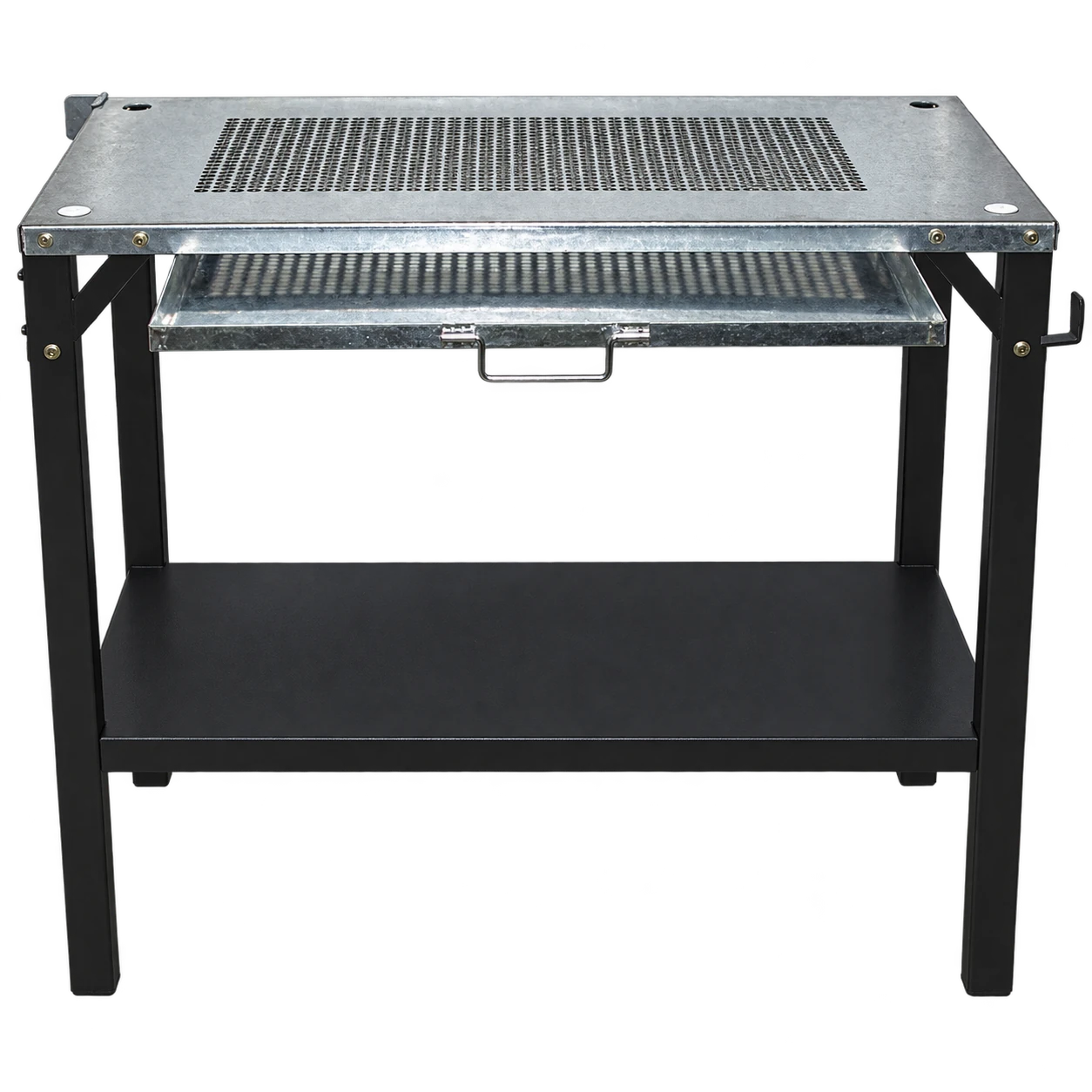
The Stanvac International WELDING TABLE gives the welder a stable, non-combustible work surface at a comfortable 36" working height. Four models are offered across two sizes and two table top materials — heavy steel mesh, which lets slag and spatter fall straight through, and galvanized 14G steel sheet with a slag tray underneath.
Product details
Key Features and Benefits of Welding Table
- Two Table Top Options: Heavy steel mesh lets slag fall through; galvanized 14G steel sheet gives a solid surface.
- Load Capacity to 180Kg: The 40" x 24" models carry 180Kg / 400Lbs; the 36" x 20" models carry 100Kg / 220Lbs.
- Folding Legs Option: The mesh-top model folds flat for storage and transport.
- Castor Wheel Ready: Every model has slots for castor wheels so the table can be made mobile.
- Slag Tray and Bottom Shelf: Sheet-top models include a slag tray, and one variant adds a bottom storage shelf.
Specifications of Welding Table
The table below lists the models available in the Welding Table range.
| Size | Table Top Material | Load Capacity | Features |
|---|---|---|---|
| 40" (L) x 24" (W) x 36" (H) | Heavy Steel Mesh | 180Kg / 400Lbs | Folding Legs, Slot for Castor Wheel |
| 40" (L) x 24" (W) x 36" (H) | Galvanized 14G Steel Sheet | 180Kg / 400Lbs | - |
| 36" (L) x 20" (W) x 36" (H) | Galvanized 14G Steel Sheet | 100Kg / 220Lbs | Slag Tray, Slot for Castor Wheel |
| 36" (L) x 20" (W) x 36" (H) | Galvanized 14G Steel Sheet | 100Kg / 220Lbs | Slag Tray, Slot for Castor Wheel, Additional Bottom Shelf |
Applications of Welding Table
- Fabrication and welding workshops
- Construction and site erection work
- Plant maintenance and repair operations
- Training centres and tool rooms
Frequently Asked Questions
What is a welding table, and why not just weld on any bench?
A welding table is a purpose-built steel work surface designed for the specific demands of welding: it is flat and stays flat under heat, it conducts the earth return, it withstands spatter and clamping loads, and it provides fixed points for clamps and fixtures. A general workbench distorts, burns and does not give a reliable earth path.
Why does flatness matter on a welding table?
Because the table is the reference surface for every fit-up made on it. A table that has bowed under heat transfers that error into every fabricated assembly, and the error is not discovered until the parts do not fit at assembly. Flatness is the specification that separates a welding table from a steel bench.
Can the earth return be taken through the welding table?
Yes, and it is the common arrangement — clamp the earth to the table and the return path runs through the table into the work. It only works if the work is in solid metal-to-metal contact with the table, which means clearing paint, scale and slag from both contact surfaces. Intermittent table contact is a frequent and hard-to-diagnose cause of unstable arcs.
What size welding table should I buy?
Size it to the largest assembly you fabricate regularly, not the largest you have ever made. An oversized table consumes floor space and makes it harder to reach the centre; an undersized one has work overhanging and unsupported, which defeats the flatness.
What are the slots or holes in a welding table for?
They take clamps, stops and fixture components, letting the work be located and held rather than tacked to the table. This is what makes repeat fabrication consistent — the fixture holds the geometry instead of the welder holding it.
How should a welding table be maintained?
Keep the top clear of slag and spatter, since spatter sitting on the surface becomes the high point that everything afterwards is set on. An anti-spatter treatment on the top reduces adhesion considerably. Do not grind on the table top — it removes material unevenly and destroys the flatness you paid for.
Will the welding table distort from welding heat?
Any steel distorts under sufficient heat. What a properly built welding table does is resist it through top thickness and a frame designed to constrain movement. The practical discipline is not concentrating heavy welding repeatedly in the same area of the table and letting it cool between heavy jobs.
Does a welding table need to be earthed to the building?
The earth return for welding is a separate matter from the building's protective earth — the welding return goes back to the machine through the earth cable, not to building earth. Electrical safety earthing of the table, where the installation requires it, is a question for a qualified electrician working to the site's electrical regulations.

Let’s find your welding solution.
Share your requirements. We’ll help you take the next step.